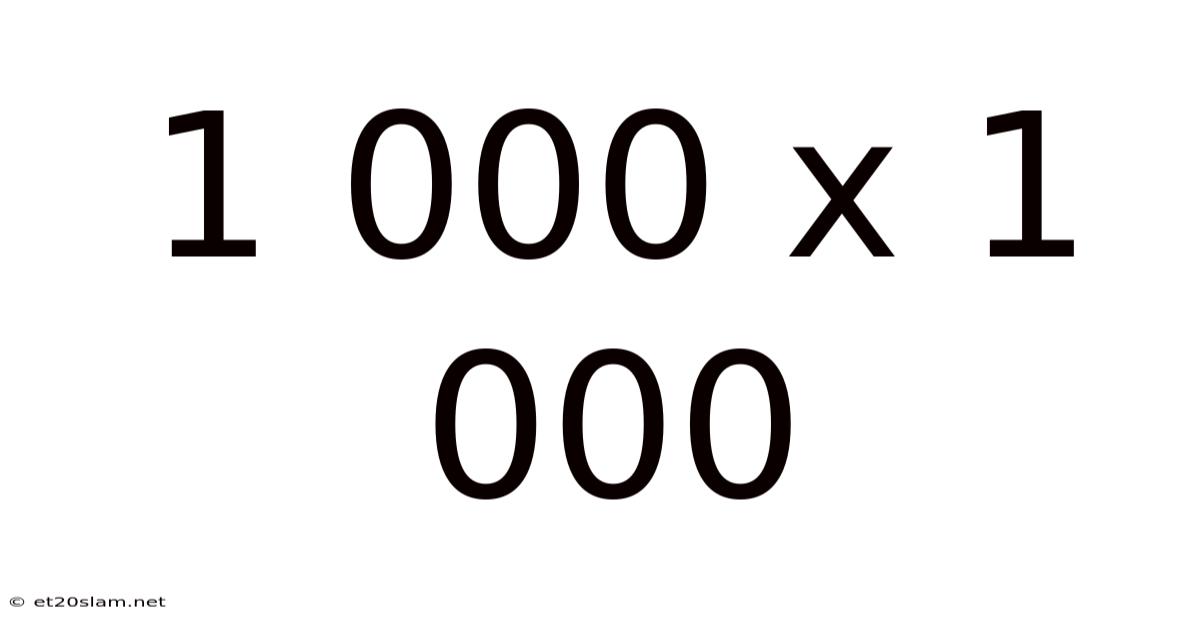
Decoding 1000 x 1000: A Deep Dive into Resolution, Pixels, and Image Quality
The seemingly simple expression "1000 x 1000" holds significant weight in the digital world, particularly in the realms of image and video resolution. Understanding what this notation means is crucial for anyone working with digital media, from amateur photographers to professional graphic designers. This article will walk through the meaning of 1000 x 1000, exploring its implications for image quality, file size, and various applications. We'll unravel the mysteries of pixels, resolution, and how these factors interplay to determine the overall visual experience.
Understanding Resolution: The Foundation of 1000 x 1000
The expression "1000 x 1000" refers to the resolution of an image or display. On top of that, resolution is simply the number of individual pixels arranged horizontally and vertically to form a complete picture. Because of that, in this case, 1000 x 1000 indicates that the image comprises 1000 pixels across its width and 1000 pixels across its height. This results in a total of 1,000,000 pixels (1000 x 1000 = 1,000,000), often referred to as one megapixel (MP) That's the whole idea..
Think of it like a grid. The more pixels you have, the finer the detail and the sharper the image appears. Each tiny square within the grid represents a single pixel. A higher resolution, like 1000 x 1000, offers significantly better detail compared to a lower resolution image, such as 640 x 480.
Pixels: The Building Blocks of Digital Images
Pixels, short for "picture elements," are the fundamental units of a digital image. But each pixel is assigned a specific color value, and the combination of millions of these colored pixels creates the image we see on our screens or printed on paper. The color of a pixel is typically represented by a combination of red, green, and blue (RGB) values. The more bits used to represent each color value (e.g., 8-bit, 16-bit, etc.And ), the more color variations are possible, leading to a richer and more vibrant image. A 1000 x 1000 image, therefore, utilizes one million individual pixels to represent the entire image, potentially allowing for complex detail and fine lines.
1000 x 1000 in Different Contexts
The significance of a 1000 x 1000 resolution varies depending on the application.
-
Photography: A 1000 x 1000 image is considered relatively low resolution by today's standards for professional photography. Modern smartphones often produce images with significantly higher resolutions, exceeding 12 megapixels (e.g., 4000 x 3000). That said, 1000 x 1000 is still sufficient for many applications, such as web use, social media posting, or printing smaller images.
-
Graphic Design: For graphic design projects, a 1000 x 1000 resolution might be suitable for smaller web graphics, icons, or simple illustrations. Still, for print projects requiring high-quality output, a much higher resolution would be necessary to ensure sharp details and avoid pixelation.
-
Video: In video, resolution is usually expressed as a combination of horizontal and vertical pixels, similar to images. A 1000 x 1000 resolution would be quite low for video, especially when considering modern standards like 4K (3840 x 2160) or 8K (7680 x 4320). That said, it could be sufficient for some low-resolution video applications or older devices with limited display capabilities Still holds up..
-
Web Design: For websites, 1000 x 1000 might be acceptable for certain images, particularly those intended for smaller display areas. On the flip side, responsive web design practices often require images to scale efficiently across various screen sizes, making higher resolutions less critical than optimization for different screen densities.
File Size Implications
The file size of a 1000 x 1000 image is influenced by several factors:
-
Pixel depth (bit depth): Higher bit depth results in larger file sizes as more data is required to store the richer color information. A 24-bit image (common for RGB) will generally be larger than an 8-bit image Still holds up..
-
File format: Different file formats (JPEG, PNG, TIFF, GIF) compress image data in various ways. JPEG offers a high compression ratio, resulting in smaller file sizes, but can lead to some loss of image quality. PNG provides lossless compression, maintaining image quality, but generally results in larger files. TIFF is a lossless format often used for archiving or professional printing, while GIF is best suited for simple graphics with limited color palettes Worth keeping that in mind..
-
Image content: Images with complex details and high contrast will typically have larger file sizes than images with simpler content and smoother gradients. A 1000 x 1000 image with solid colors will be smaller than one with layered details and many variations in color and tone.
The Importance of Choosing the Right Resolution
Selecting the appropriate resolution is crucial for various reasons:
-
Image Quality: Higher resolutions generally lead to better image quality, providing sharper details and clearer text. On the flip side, excessively high resolutions might not be necessary for all applications and could lead to unnecessarily large file sizes.
-
File Size: Larger resolutions typically result in larger file sizes, which can impact storage space, upload times, and website loading speeds. Choosing an appropriate resolution helps optimize file sizes without compromising image quality significantly.
-
Print Resolution: The resolution of an image plays a vital role in print quality. Higher resolutions are crucial for producing high-quality prints without noticeable pixelation. The required resolution depends heavily on the print size and the intended output quality Most people skip this — try not to..
-
Screen Resolution: The resolution of a digital display dictates how the image will be rendered on the screen. Images with resolutions higher than the screen's native resolution might be downscaled, while those with lower resolutions may appear pixelated But it adds up..
Frequently Asked Questions (FAQ)
Q: Is 1000 x 1000 a good resolution for printing?
A: It depends on the print size. In practice, for small prints, 1000 x 1000 might be sufficient. Even so, larger prints would require a much higher resolution to maintain sharpness and avoid pixelation. For professional printing, resolutions significantly higher than 1000 x 1000 are usually needed.
Short version: it depends. Long version — keep reading.
Q: What is the difference between resolution and DPI (dots per inch)?
A: Resolution refers to the number of pixels in an image, while DPI refers to the number of ink dots printed per inch. Day to day, while both relate to image clarity, they represent different aspects of the image reproduction process. Resolution is intrinsic to the digital image itself, while DPI is related to the printing process.
Q: How can I resize an image without losing quality?
A: Resizing an image typically involves changing its resolution. Think about it: reducing the resolution generally causes less quality loss, but some detail might still be lost. Think about it: enlarging an image beyond its original resolution will likely result in some loss of quality and pixelation. Using image editing software with good resampling algorithms can minimize quality loss during resizing That's the part that actually makes a difference..
Short version: it depends. Long version — keep reading And that's really what it comes down to..
Q: What are some alternative resolutions to consider?
A: The choice of resolution often depends on the intended use. Common alternatives include:
- 720 x 720: Suitable for smaller images and low-resolution displays.
- 1280 x 720 (720p): A common standard for HD video.
- 1920 x 1080 (1080p): A common standard for Full HD video and displays.
- 3840 x 2160 (4K): A high-resolution standard for ultra-high-definition displays and videos.
Conclusion: Understanding the Nuances of Resolution
The seemingly simple "1000 x 1000" designation reveals a wealth of information about image quality, file size, and intended use. Even so, understanding the relationship between resolution, pixels, and file formats is crucial for anyone working with digital images or videos. While 1000 x 1000 might suffice for certain applications, it’s crucial to consider the specific needs of your project and select the appropriate resolution to optimize both image quality and file size efficiency. Choosing the right resolution ensures that your images look their best, whether displayed on screen, printed on paper, or used in other digital applications. Remember to always consider the context—intended use, print size, display capabilities—when determining the ideal resolution for your digital assets Turns out it matters..
Easier said than done, but still worth knowing.
