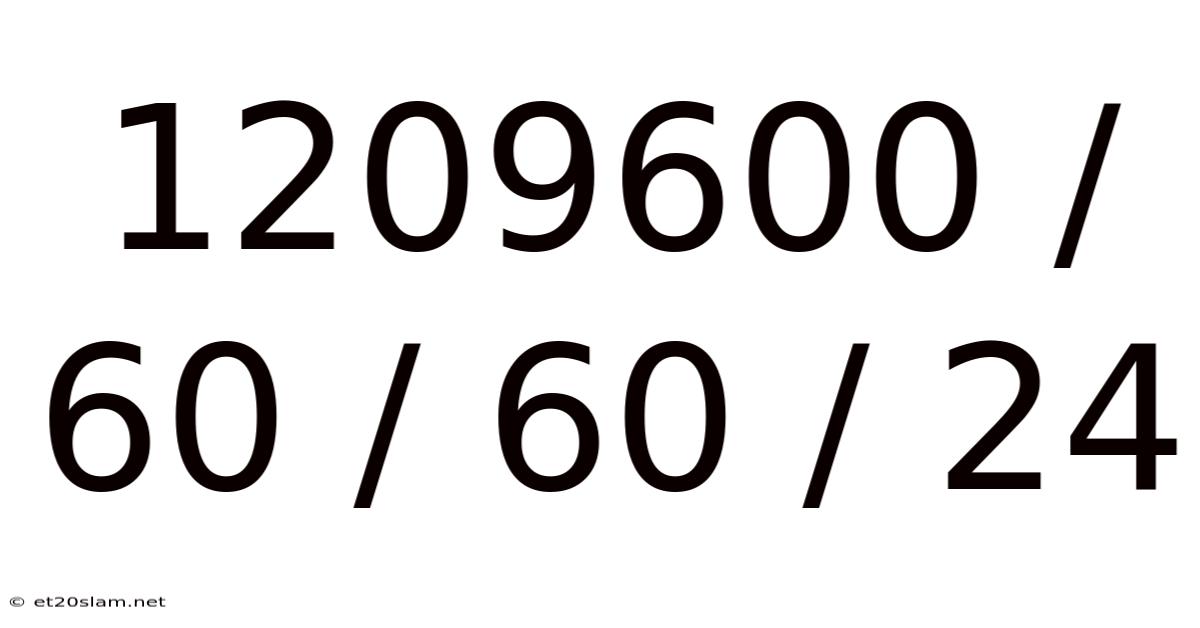
Decoding 1209600 / 60 / 60 / 24: Understanding Time Conversion and its Applications
This article looks at the meaning and implications of the mathematical expression 1209600 / 60 / 60 / 24. Day to day, we'll break down the calculation step-by-step, explore the underlying concepts of time conversion, and discuss practical applications where this type of calculation is crucial. Understanding this seemingly simple equation provides valuable insights into time management, data analysis, and various scientific fields Less friction, more output..
This is the bit that actually matters in practice.
Understanding the Fundamentals: Units of Time
Before we dive into the calculation, let's establish a strong foundation by reviewing the standard units of time. We commonly use seconds, minutes, hours, and days to measure durations. The relationships between these units are fundamental to our understanding:
- 1 minute (min) = 60 seconds (sec)
- 1 hour (hr) = 60 minutes (min)
- 1 day (day) = 24 hours (hr)
These conversion factors are the key to solving our equation. The expression 1209600 / 60 / 60 / 24 essentially involves converting a large number of seconds into days.
Step-by-Step Calculation: From Seconds to Days
Let's break down the calculation of 1209600 / 60 / 60 / 24:
-
Divide by 60 (seconds to minutes): The first step is to convert the initial number of seconds (1209600) into minutes. We do this by dividing by 60:
1209600 sec / 60 sec/min = 20160 min
-
Divide by 60 (minutes to hours): Next, we convert the minutes (20160) into hours by dividing by 60 again:
20160 min / 60 min/hr = 336 hr
-
Divide by 24 (hours to days): Finally, we convert the hours (336) into days by dividing by 24:
336 hr / 24 hr/day = 14 days
Which means, 1209600 seconds is equivalent to 14 days.
The Significance of the Calculation: Applications in Real-World Scenarios
This seemingly simple calculation has significant implications across various fields:
-
Data Analysis: In data analysis, large datasets often involve timestamps recorded in seconds. Converting these timestamps into more user-friendly units like days, hours, or minutes is essential for interpreting trends and patterns. Imagine analyzing server logs where events are timestamped in seconds; converting these timestamps to days would allow for easier analysis of daily activity.
-
Project Management: In project management, accurately estimating timelines and tracking progress often requires converting between different units of time. If a project has a deadline expressed in days, but individual tasks are measured in hours or even seconds (e.g., processing time for a specific task), converting these units consistently is crucial for effective planning and monitoring.
-
Scientific Research: Many scientific experiments and observations involve measuring durations. Whether it’s tracking the lifespan of a biological specimen, measuring the decay rate of a radioactive substance, or analyzing astronomical events, precise time conversion is critical for obtaining accurate results. Consider research involving celestial events; calculations often need to precisely convert seconds into days, years, or even centuries for accurate predictions.
-
Software Development: Software developers often work with timestamps and durations. Converting between different units of time is essential for tasks such as debugging, performance analysis, and optimizing code execution times. To give you an idea, understanding the execution time of a code segment in seconds and converting it into minutes or hours can inform the efficiency of the software Small thing, real impact..
Beyond the Basics: Working with Other Time Units
While our focus has been on converting seconds to days, the principles extend to other time unit conversions. Take this case: you might need to convert:
- Seconds to weeks: Simply extend the calculation by dividing the number of days by 7 (days per week).
- Hours to weeks: Divide the number of hours by 24 (hours per day) and then by 7 (days per week).
- Minutes to months: This requires more steps as it involves converting to hours, days, and then approximating weeks to months (considering the variable number of days in a month).
Addressing Potential Challenges and Errors
While the calculations themselves are straightforward, several potential challenges and error sources exist:
-
Unit Inconsistency: confirm that all units used in the calculations are consistent. Mixing seconds, minutes, and hours without proper conversion factors will lead to inaccurate results.
-
Rounding Errors: When dealing with large numbers or many conversion steps, rounding errors can accumulate and affect the final result. Using sufficient decimal places during intermediate calculations can minimize these errors Most people skip this — try not to..
-
Leap Years: When dealing with longer time periods (years), accounting for leap years is important for precise calculations. A simple conversion from days to years will not be accurate if leap years are not considered.
Frequently Asked Questions (FAQ)
Q1: What happens if the initial number of seconds isn't perfectly divisible by 60 and 24?
A1: You'll obtain a decimal result representing a fraction of a day, hour, or minute. Take this case: if the division leaves a remainder, you can express the result as a whole number of days plus a fraction of a day, or convert the fractional part into hours and minutes.
Q2: Are there any online tools or calculators for time conversions?
A2: Yes, many online tools and calculators are available to perform time unit conversions efficiently and accurately. These tools can handle complex conversions involving various units and even account for leap years And that's really what it comes down to..
Q3: How is this calculation relevant to everyday life?
A3: While we might not perform this specific calculation daily, the underlying principle of time conversion is used implicitly in numerous aspects of daily life. We all intuitively convert between hours and minutes when scheduling events, planning travel, or estimating task completion times And that's really what it comes down to..
Conclusion: Mastering Time Conversion for Practical Applications
The calculation 1209600 / 60 / 60 / 24 provides a practical example of how essential time conversions are. Understanding the principles involved and mastering the techniques allows for accurate data analysis, efficient project management, and precise scientific measurements. Here's the thing — the ability to smoothly convert between different units of time is a valuable skill across many disciplines, and the seemingly simple equation explored here acts as a gateway to a deeper understanding of time management and data manipulation. On the flip side, by appreciating the interconnectedness of these time units, we can effectively handle the complexities of data analysis, project planning, and various scientific endeavors. The core principle remains consistent – the methodical application of conversion factors ensures accurate and meaningful interpretation of temporal data.
