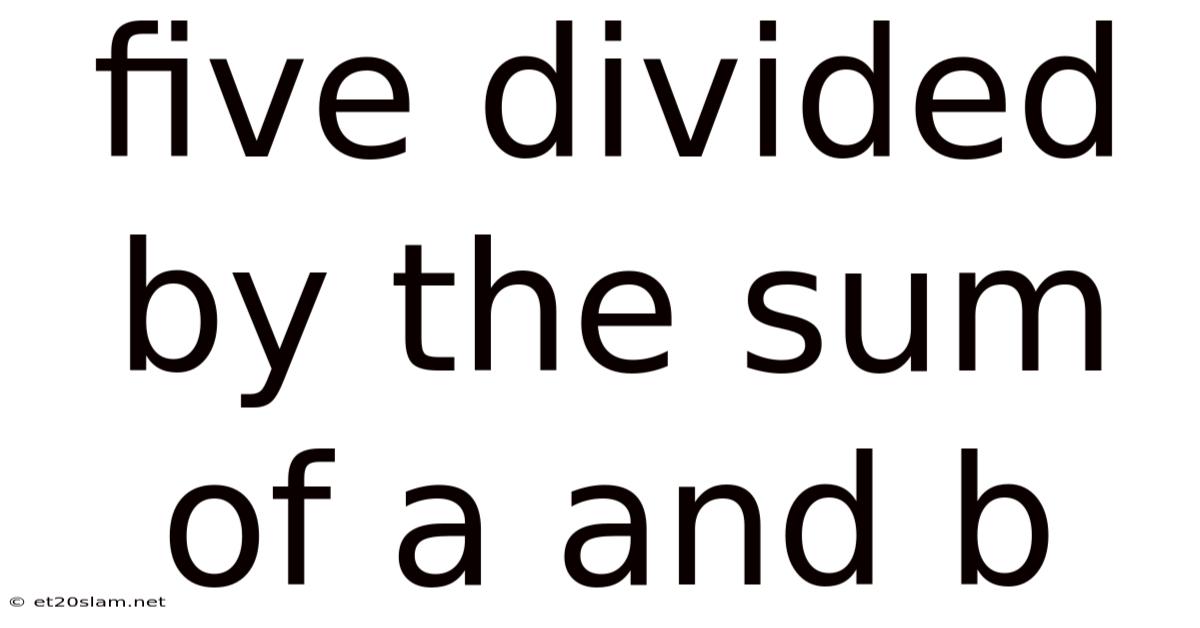
Five Divided by the Sum of a and b: A Deep Dive into Mathematical Expressions
This article explores the mathematical expression "five divided by the sum of a and b," examining its various interpretations, applications, and potential complexities. We'll get into the fundamental concepts, explore different scenarios, and address common misconceptions. Because of that, understanding this seemingly simple expression lays a crucial foundation for more advanced mathematical concepts. The keyword phrase is five divided by the sum of a and b, and we'll naturally incorporate related semantic keywords throughout the text.
Introduction: Deconstructing a Simple Expression
At its core, the phrase "five divided by the sum of a and b" represents a fundamental arithmetic operation. This order of operations, often remembered by the acronym PEMDAS (Parentheses, Exponents, Multiplication and Division, Addition and Subtraction), is fundamental in mathematics. The parentheses are crucial; they indicate that the addition of 'a' and 'b' must be performed before the division by 5. It translates directly into the algebraic expression: 5 / (a + b). Neglecting the parentheses could lead to significantly different, and incorrect, results It's one of those things that adds up..
This simple expression might seem trivial at first glance. That said, its simplicity belies its versatility and importance in various mathematical contexts, ranging from basic algebra to more complex fields like calculus and statistics. We'll examine how this expression arises in different situations and how its interpretation can change depending on the context Surprisingly effective..
No fluff here — just what actually works Easy to understand, harder to ignore..
Understanding the Components: Variables and Operations
Before delving deeper, let's understand the key components of the expression:
- 5: This is a constant, a fixed numerical value. It remains unchanged regardless of the values assigned to 'a' and 'b'.
- a and b: These are variables, representing unknown or unspecified quantities. They can take on any numerical value (integers, decimals, fractions, etc.), positive or negative, making the expression highly adaptable.
- +: This is the addition operator, indicating the sum of 'a' and 'b'.
- /: This is the division operator, indicating that 5 is divided by the sum of 'a' and 'b'.
The interplay between these components determines the final result. The value of the expression 5 / (a + b) is wholly dependent on the values assigned to the variables 'a' and 'b'.
Evaluating the Expression: Different Scenarios and Examples
Let's explore several scenarios to illustrate how the expression behaves with different values for 'a' and 'b':
Scenario 1: Positive Integers
Let's say a = 2 and b = 3. Substituting these values into the expression, we get:
5 / (2 + 3) = 5 / 5 = 1
In this case, the result is a simple integer, 1 Worth knowing..
Scenario 2: Negative Numbers
Let's consider a = -2 and b = -3. The calculation becomes:
5 / (-2 + -3) = 5 / -5 = -1
Here, the result is -1, highlighting the importance of considering the signs of the variables Small thing, real impact..
Scenario 3: Decimal Values
Let's use decimal values: a = 1.Think about it: 5 and b = 2. 5 But it adds up..
5 / (1.5 + 2.5) = 5 / 4 = 1.
This demonstrates that the expression can produce decimal results as well No workaround needed..
Scenario 4: Zero and Undefined Results
What happens if a + b = 0? The expression becomes meaningless in this case. Practically speaking, this emphasizes the critical role of the denominator and the need to avoid division by zero. But this creates a situation where we attempt to divide by zero, which is undefined in mathematics. Take this: if a = 2 and b = -2, the expression becomes 5/(2 + (-2)) = 5/0, which is undefined.
Applications in Different Fields
The simple expression "five divided by the sum of a and b" appears surprisingly often in various mathematical and real-world contexts:
-
Algebra: This expression serves as a building block for more complex algebraic equations and functions. It illustrates the fundamental principles of variable substitution and order of operations Easy to understand, harder to ignore..
-
Statistics: The expression might appear in statistical calculations, particularly those involving averages or weighted averages. Here's one way to look at it: if 'a' and 'b' represent the number of successes in two different trials, and 5 represents a total weight or weighting factor, then the expression might represent a weighted average success rate Simple, but easy to overlook..
-
Physics and Engineering: Many physical quantities are related through equations that involve similar expressions. As an example, in calculating average velocity or resistance in a circuit, we might encounter expressions where a constant is divided by the sum of two variables And that's really what it comes down to..
-
Computer Science: This type of expression is frequently encountered in programming, where it's used to perform calculations and manipulate data Less friction, more output..
Addressing Common Misconceptions
One frequent mistake is incorrectly applying the order of operations. Always remember that the parentheses dictate the order of operations. Students sometimes calculate 5 / a + b instead of 5 / (a + b), leading to incorrect results. The sum of a and b must be calculated first That's the part that actually makes a difference..
Another misconception arises when dealing with negative numbers. Students might struggle with the signs when adding or dividing negative values. Practicing with a variety of examples, including negative numbers and decimals, is essential to build proficiency.
Expanding the Expression: Introduction to Functions
The expression 5 / (a + b) can be considered a function. In functional notation, we might write it as:
f(a, b) = 5 / (a + b)
This notation emphasizes that the expression's value depends on the input values 'a' and 'b'. Understanding this function concept opens doors to more advanced mathematical ideas, such as function domains (the values 'a' and 'b' can take), ranges (the possible output values), and graphing functions in two or three dimensions.
Further Exploration: More Complex Scenarios
We can extend this fundamental expression to explore more complex scenarios:
-
Multiple Variables: We could generalize the expression to include more than two variables: 5 / (a + b + c + ...). The principles remain the same; the sum of all variables must be calculated first, followed by the division.
-
Exponents and other Operations: We could incorporate exponents, multiplication, or other operations within the expression, making it even more detailed. For instance: 5 / (a² + b) or 5 * (a + b) / (c - d). On the flip side, the core principle of prioritizing operations within parentheses remains consistent.
-
Inequalities: Instead of equating the expression to a specific value, we might explore inequalities, for example, 5 / (a + b) > 2. This requires solving for the range of values for 'a' and 'b' that satisfy the inequality Simple, but easy to overlook..
Conclusion: The Significance of Simplicity
While seemingly simple, the expression "five divided by the sum of a and b" provides a solid platform for understanding fundamental mathematical concepts. In practice, mastering the order of operations, the roles of constants and variables, and the implications of division by zero are critical steps in developing strong mathematical proficiency. This seemingly simple expression offers a gateway to more advanced concepts in algebra, calculus, statistics, and other fields. That's why strip it back and you get this: that a thorough understanding of fundamental mathematical operations allows for a deeper comprehension of more complex concepts in the future. By diligently studying and practicing these fundamental ideas, you will establish a solid mathematical foundation for future learning and problem-solving. Remember, even the most complex mathematical concepts are built upon these basic building blocks Worth keeping that in mind..
