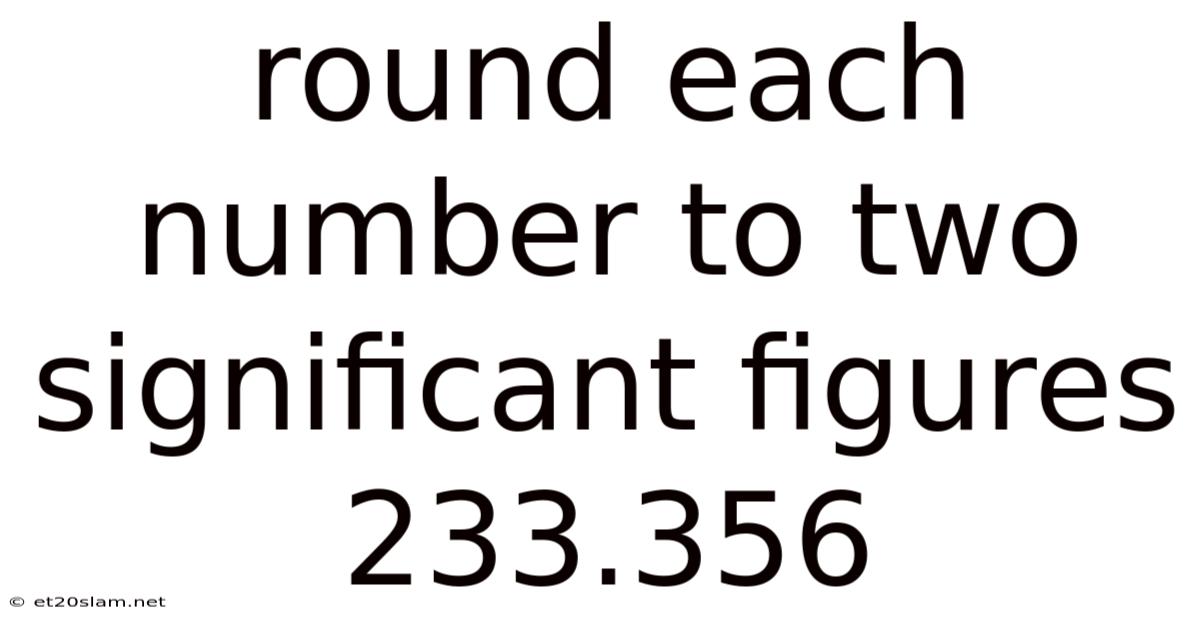
Rounding Numbers to Two Significant Figures: A thorough look
Rounding numbers is a fundamental skill in mathematics and science, crucial for simplifying calculations and presenting data concisely. In real terms, this practical guide will get into the process of rounding, specifically focusing on rounding numbers to two significant figures. We'll explore the concept of significant figures, the rules for rounding, and tackle common challenges, ultimately equipping you with a solid understanding of this essential mathematical technique. Even so, we'll use the number 233. 356 as a recurring example to illustrate the process.
Understanding Significant Figures
Before diving into rounding, it's crucial to understand what significant figures are. That said, significant figures (or significant digits) are the digits in a number that carry meaning contributing to its precision. Here's the thing — they represent the reliable digits in a measurement or calculation. Zeroes can be tricky; they are significant when they are between other non-zero digits, at the end of a number with a decimal point, or if they are explicitly stated to be significant That's the part that actually makes a difference. Practical, not theoretical..
Rules for Determining Significant Figures:
- Non-zero digits are always significant. Here's one way to look at it: in 233.356, the digits 2, 3, 3, 3, 5, and 6 are all significant.
- Zeroes between non-zero digits are significant. In the number 1005, the zero is significant.
- Leading zeroes (zeroes to the left of the first non-zero digit) are not significant. In 0.0025, only 2 and 5 are significant.
- Trailing zeroes (zeroes at the end of a number) are significant only if the number contains a decimal point. In 2500, only 2 and 5 are significant. That said, in 2500.0, all five digits are significant.
- Exact numbers have infinite significant figures. Numbers obtained by counting (e.g., 3 apples) or defined constants (e.g., π, or exactly 2) are considered to have infinite significant figures.
Rounding to Two Significant Figures: The Process
Rounding a number to two significant figures means expressing it with only two reliable digits. The process involves identifying the first two significant digits and then considering the digit immediately following them to determine whether to round up or down And that's really what it comes down to..
Step-by-Step Guide:
-
Identify the first two significant figures: In our example, 233.356, the first two significant figures are 2 and 3.
-
Examine the third significant figure: The third significant figure is 3.
-
Apply the rounding rule: If the third significant figure is 5 or greater, round the second significant figure up. If it is less than 5, keep the second significant figure as it is. In our case, the third significant figure is 3, which is less than 5 The details matter here. Nothing fancy..
-
Round down and truncate: Since the third significant figure (3) is less than 5, we round down. This means we keep the second significant figure as it is and drop all digits to the right. Which means, 233.356 rounded to two significant figures is 230. Note that we retain the zero as a place holder, even though trailing zeroes after a whole number without a decimal point are not normally considered significant figures. This maintains the magnitude of the number.
Examples of Rounding to Two Significant Figures
Let's consider various examples to solidify our understanding:
-
3456.78: The first two significant figures are 3 and 4. The third significant figure is 5, so we round up. The result is 3500.
-
0.00127: The first two significant figures are 1 and 2. The third significant figure is 7, so we round up. The result is 0.0013. Note the leading zeros remain to show the magnitude.
-
19.99: The first two significant figures are 1 and 9. The third significant figure is 9, so we round up. The result is 20.
-
98.4: The first two significant figures are 9 and 8. The third significant figure is 4, so we keep the number as it is. The result is 98 Worth knowing..
-
1001: The first two significant figures are 1 and 0. The third significant figure is 0, so we keep the number as it is. The result is 1000. Note here the trailing zeroes are necessary.
Scientific Notation and Significant Figures
For very large or very small numbers, scientific notation is often used. Scientific notation expresses a number in the form a x 10<sup>b</sup>, where 'a' is a number between 1 and 10, and 'b' is an integer. When rounding to a specific number of significant figures in scientific notation, you only round the 'a' value That alone is useful..
Here's one way to look at it: 1234567 rounded to two significant figures in scientific notation would be 1.2 x 10<sup>6</sup>.
Rounding Errors and Propagation
don't forget to understand that rounding introduces a small error. So this error can propagate (accumulate) in complex calculations if not managed properly. Now, in many scientific and engineering applications, strategies to minimize the impact of rounding errors are crucial. To give you an idea, delaying rounding until the final stages of calculations can often help Simple, but easy to overlook..
Frequently Asked Questions (FAQ)
Q: What happens if the third significant figure is exactly 5?
A: There are different conventions for handling a third significant figure of exactly 5. Some round up consistently, while others round to the nearest even number. Here's a good example: 125 would round to 120, while 135 would round to 140. Consistency within a given calculation is key It's one of those things that adds up..
Q: Can I round to two significant figures in different bases (other than base 10)?
A: Yes, the principles of rounding to a specific number of significant figures apply to any base. On the flip side, the process of identifying the significant figures and the value of the digit to round based on its position in the number would depend on the specific base Small thing, real impact..
Q: Why is rounding important?
A: Rounding simplifies data representation and makes it more manageable. In practice, it's also crucial for presenting results appropriately, given the limitations of measurement precision. It avoids reporting false precision That alone is useful..
Conclusion
Rounding to two significant figures is a simple yet vital skill in various fields. Remember to maintain consistency in your rounding methodology, and always consider the practical implications of your chosen rounding methods in the specific context of your calculations or data representation. Plus, by understanding the concept of significant figures and applying the correct rounding rules, you can confidently handle numerical data and present results accurately and concisely. Remembering the process, applying the rules consistently, and considering the implications of rounding errors will make you proficient in handling significant figures in any context. This detailed guide should provide you with the necessary knowledge and skills to accurately round numbers to two significant figures and beyond Turns out it matters..
