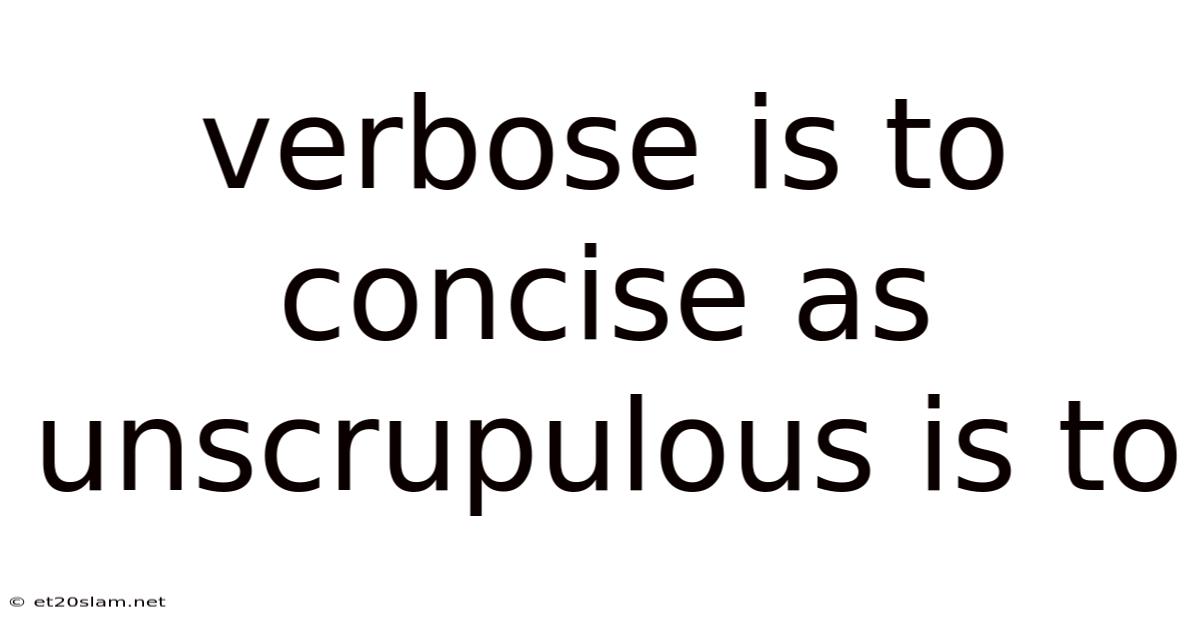
Verbose is to Concise as Unscrupulous is to: Exploring Antonyms and Their Nuances
The analogy "verbose is to concise as unscrupulous is to __" presents a fascinating challenge. It requires us to identify the antonym of "unscrupulous," but more importantly, to understand the underlying relationship between the word pairs. Here's the thing — this isn't simply about finding an opposite; it's about recognizing the parallel in the nature of the contrast. Think about it: "Verbose" and "concise" represent a spectrum of wordiness; we need to find a pair that similarly represents a spectrum of ethical behavior. Let's break down this, exploring potential answers and the complexities of antonyms.
Understanding the Analogy: Opposites and Degrees
The core of the analogy lies in understanding the relationship between antonyms. Even so, the ideal lies somewhere in between. Here's the thing — g. It describes a lack of moral principles, a disregard for ethical standards. "Verbose" isn't just the opposite of "concise"; it represents an excess of words, whereas "concise" implies a lack of unnecessary words. Now, , black and white), many exist on a spectrum. In real terms, similarly, "unscrupulous" doesn't simply have one perfect opposite. While some antonyms are absolute opposites (e.The opposite would represent a high degree of ethical conduct.
Several words could potentially fit into the blank, each with subtly different implications:
-
Scrupulous: This is the most straightforward answer. Scrupulousness implies a diligent and careful regard for morality and ethics. It's the direct antonym of unscrupulous, mirroring the straightforward antonymic relationship between verbose and concise. The analogy becomes: verbose is to concise as unscrupulous is to scrupulous. This is a strong and accurate pairing, highlighting the direct opposition between ethical extremes.
-
Honest: Honesty is a key component of scrupulousness, but it's a narrower concept. While an honest person is likely to be scrupulous, a scrupulous person isn't necessarily honest in every situation. Take this: a scrupulous lawyer might fiercely defend a client they believe is guilty, adhering to ethical legal standards even if it means defending someone dishonest. So, while honesty is related, it's not as precise a fit as scrupulous.
-
Principled: This term emphasizes the adherence to a strong moral code. A principled individual acts according to their deeply held beliefs about right and wrong. This is very similar to scrupulous, perhaps slightly stronger in its implication of unwavering commitment to ethical principles. The analogy holds true, although with a slightly different nuance: verbose is to concise as unscrupulous is to principled.
-
Ethical: Similar to "principled," ethical describes behavior that conforms to accepted standards of morality. It's a broad term encompassing many aspects of right conduct. This works well in the analogy, providing a slightly broader perspective than "scrupulous" or "principled," encompassing a wider range of ethical behaviors. The analogy becomes: verbose is to concise as unscrupulous is to ethical.
-
Conscientious: This highlights a strong sense of moral obligation and a dedication to doing what's right. A conscientious person is meticulous and thoughtful in their actions, ensuring they align with their moral compass. This is a very close fit to "scrupulous," focusing more on the diligent aspect of ethical behavior Nothing fancy..
Delving Deeper: The Spectrum of Ethical Behavior
The analogy isn't just about finding simple opposites; it's about capturing the essence of the gradient between extremes. Consider the following:
-
Unscrupulous: This represents a complete absence of moral constraints, a willingness to exploit or deceive for personal gain. This includes actions like fraud, theft, bribery, and other unethical practices Easy to understand, harder to ignore. That's the whole idea..
-
Scrupulous: This sits at the opposite end of the spectrum. It implies a meticulous adherence to ethical principles, a commitment to honesty and fairness, even when it's difficult or inconvenient. This would involve actions like reporting wrongdoing, refusing to compromise ethical standards, and acting with integrity in all circumstances Worth keeping that in mind..
-
The Middle Ground: Between these two extremes lies a vast spectrum of ethical behavior. Individuals may exhibit varying degrees of scrupulousness, sometimes acting ethically and sometimes falling short, depending on the circumstances and personal temptations. This spectrum mirrors the spectrum between verbose and concise writing – some writing is overly wordy, some is overly brief, and most writing lies somewhere in between, striving for clarity and efficiency.
Expanding the Analogy: Beyond Simple Antonyms
The strength of the analogy lies not just in the direct antonymy but in the inherent relationship between the concepts. Which means both pairs deal with extremes and the spectrum between them. Verbosity is a stylistic choice that can range from slightly wordy to excessively rambling, affecting clarity and readability. Similarly, ethical behavior is a spectrum, ranging from utter disregard for morality to unwavering adherence to ethical principles Small thing, real impact..
The key takeaway is that choosing the "best" answer depends on the desired nuance. In real terms, "Scrupulous" offers the most direct antonym, creating a tight and accurate analogy. Even so, "principled," "ethical," and "conscientious" offer slightly broader perspectives, each highlighting a different facet of ethical behavior Easy to understand, harder to ignore..
Frequently Asked Questions (FAQ)
Q: Why isn't "moral" a good fit for the analogy?
A: While "moral" is related to ethics, it's a broader term encompassing a wider range of beliefs and values. "Scrupulous," "principled," "ethical," and "conscientious" focus more specifically on the actions taken in accordance with those beliefs, providing a closer parallel to the action of writing concisely or verbosely Took long enough..
Q: Could "honest" be considered a suitable answer?
A: Honesty is a significant component of ethical behavior, but it's not the complete picture. A person can be honest but still make unethical choices due to other factors, such as naivety or lack of awareness. "Scrupulous" encompasses a wider range of ethical considerations, making it a more fitting antonym for "unscrupulous.
Q: What makes "scrupulous" the best answer?
A: "Scrupulous" offers the most precise and direct antonym for "unscrupulous.So " It mirrors the clear antonymic relationship between "verbose" and "concise," providing the strongest parallel in the analogy. Other options are valid, but they might introduce additional nuances that slightly weaken the direct comparison Turns out it matters..
Q: How can I use this analogy in everyday life?
A: This analogy helps highlight the importance of understanding not just the opposites of concepts but the spectrum between them. It encourages critical thinking about both stylistic choices (like writing) and ethical decisions. By recognizing the gradations, we can improve our writing and make more thoughtful ethical judgments.
Conclusion: The Nuances of Opposites
The analogy "verbose is to concise as unscrupulous is to __" is more complex than it initially appears. While "scrupulous" provides the most direct and accurate antonym, other options like "principled," "ethical," and "conscientious" offer valuable nuances. Day to day, the key takeaway is understanding the spectrum inherent in both word pairs – the range between excessive wordiness and precise brevity, and the range between complete moral disregard and unwavering ethical commitment. By exploring these nuances, we gain a deeper understanding of antonyms and the complexities of language and ethical behavior. The analogy encourages us to think critically about the spectrum of options and the implications of choosing one extreme over another, a valuable exercise in both writing and ethical decision-making Most people skip this — try not to..
